
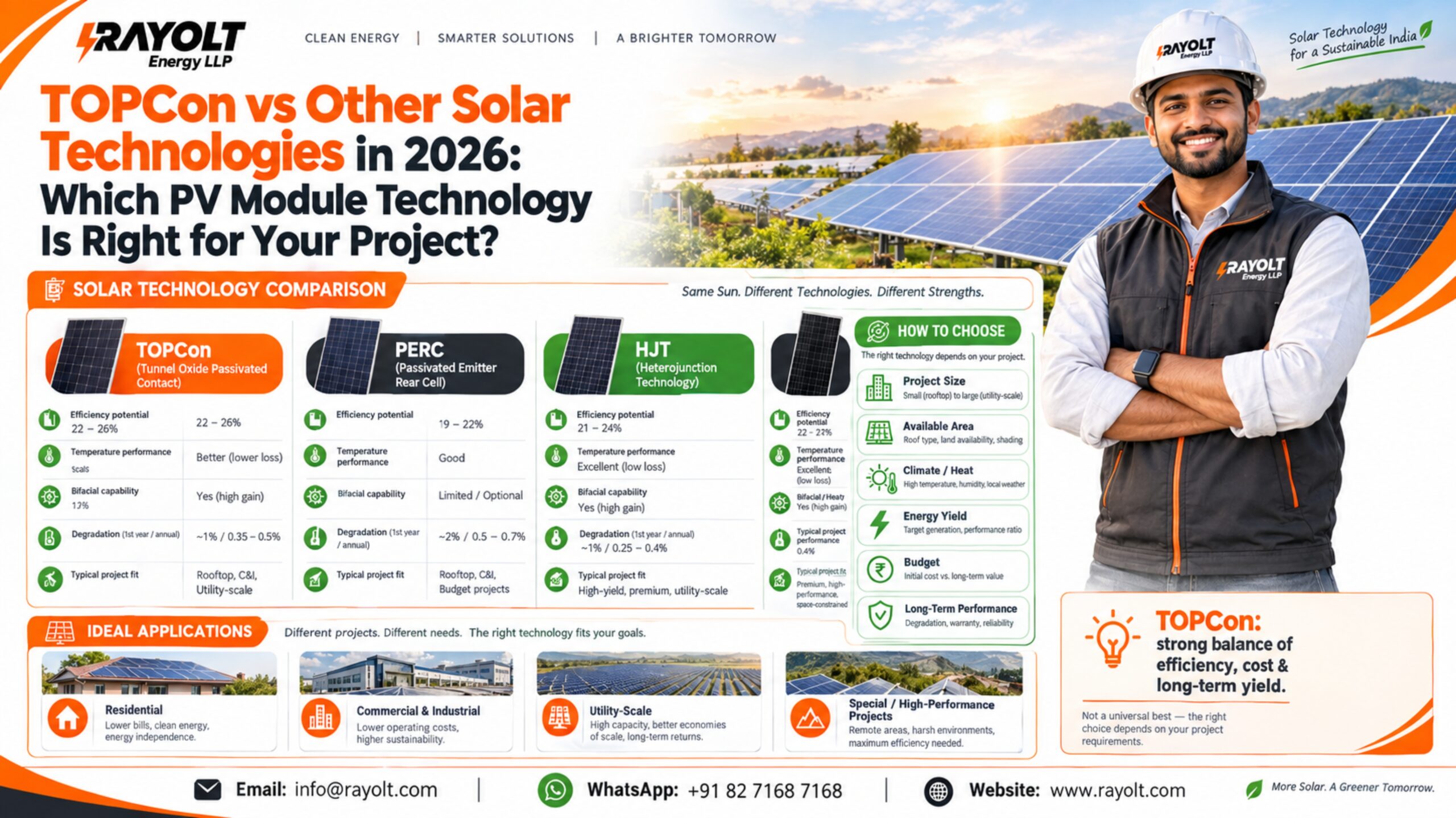
Solar PV technology is evolving rapidly, giving businesses, industries, commercial facilities, and homeowners more options when selecting solar modules. Among the technologies available today, TOPCon solar panels have become an important option for projects looking for high-performance photovoltaic modules.
However, TOPCon is not the only technology available. PERC, HJT, IBC, and other advanced module technologies have different characteristics related to efficiency, temperature performance, degradation, space utilization, and project economics.
So, how should you choose the right PV module technology for your project in 2026?
In this guide, Rayolt Energy LLP explains TOPCon Solar Panel Technology, compares it with other major technologies, and highlights the factors that should be considered before selecting modules for residential, commercial, and industrial solar projects.
🔆 What Is TOPCon Solar Panel Technology?
TOPCon stands for Tunnel Oxide Passivated Contact. It is an advanced crystalline silicon solar cell technology designed to improve cell passivation and reduce electrical losses.
Most TOPCon Solar Modules are based on n-type silicon, which can provide advantages in efficiency, degradation characteristics, and performance under certain operating conditions.
The technology is increasingly being considered for new solar installations where project owners want to balance module efficiency, available installation space, energy generation, and long-term performance.
For an Industrial Solar Project, module selection should not be based on efficiency alone. System design, roof or land availability, electricity consumption, inverter compatibility, environmental conditions, and project economics also matter.
⚡ Why Are TOPCon Solar Panels Getting Attention in 2026?
One of the key reasons TOPCon Solar Panels are receiving attention is their combination of efficiency and n-type cell architecture.
Depending on the specific module and manufacturer, TOPCon technology can offer:
✅ High module efficiency
✅ Good energy generation potential
✅ Lower degradation characteristics compared with some older technologies
✅ Good performance under different operating conditions
✅ Suitability for rooftop and ground-mounted applications
✅ Higher power output per module
The actual performance, however, depends on the specific module design, installation conditions, system configuration, and manufacturer specifications.
For businesses evaluating TOPCon Solar Modules, it is therefore important to compare the complete technical datasheet rather than looking at one specification.On Grid Solar System Price In India depends on system capacity, solar panels, inverter, installation, structure, and applicable regulations. Explore key cost factors, savings potential, and important considerations before choosing an on-grid solar system for your home or business with Rayolt.com.
🔍 TOPCon vs Mono PERC Solar Panels
PERC has been widely used in the solar industry and has played an important role in increasing mainstream PV module efficiency.
When comparing TOPCon vs Mono PERC, several factors should be considered.
TOPCon
✅ Generally uses n-type cell architecture
✅ High efficiency potential
✅ Designed for lower electrical losses
✅ Strong option for new projects
✅ Available in many high-power module formats
Mono PERC
✅ Mature and widely deployed technology
✅ Established manufacturing ecosystem
✅ Proven in many solar applications
✅ Often available at competitive project pricing
✅ Suitable for a wide range of installations
For a new project in 2026, project owners can compare module efficiency, warranty, degradation, product availability, and total system cost before selecting between technologies.
🌡️ TOPCon vs HJT Solar Panels
Another important comparison is TOPCon vs HJT Solar Panels.
HJT, or Heterojunction Technology, combines crystalline silicon with thin-film layers to create a high-performance solar cell structure.
Both TOPCon Solar Panels and HJT modules can provide high efficiency, but their manufacturing technologies and product characteristics differ.
TOPCon
🔹 n-type technology
🔹 High efficiency potential
🔹 Broad product availability
🔹 Suitable for residential, commercial, and industrial applications
🔹 Strong option for large-scale deployment
HJT
🔹 High-efficiency cell architecture
🔹 Strong temperature-performance characteristics in suitable conditions
🔹 Low temperature coefficient in many product designs
🔹 Increasing adoption in high-performance applications
When comparing TOPCon vs HJT Solar Panels, the right choice depends on the project’s climate, space limitations, energy-generation requirements, module pricing, and long-term financial model. Looking for a reliable Reliance Authorized Channel Partner for solar solutions? Rayolt.com provides professional support for solar products and project requirements, helping customers explore suitable solutions, installation services, and technical assistance for residential, commercial, and industrial applications.
🧪 TOPCon vs Other Solar Technologies
Beyond PERC and HJT, the solar industry includes technologies such as IBC and other advanced cell architectures.
There is no single module technology that is automatically suitable for every project.
A useful comparison should consider:
| Factor | TOPCon | Mono PERC | HJT | IBC |
| Cell type | Generally n-type | P-type | N-type | N-type |
| Efficiency potential | High | High | High | High |
| Technology maturity | Growing/mature | Mature | Growing | Advanced |
| Typical applications | Rooftop, C&I, utility | Broad applications | High-performance projects | Premium applications |
| Key consideration | Efficiency + economics | Cost + availability | Performance + technology | Efficiency + product availability |
Actual specifications vary by manufacturer and individual module model, so project owners should always check the current datasheet and warranty documentation.
🏭 Are TOPCon Solar Panels Suitable for Industrial Projects?
Yes, TOPCon Solar Panels can be considered for industrial projects where high-power and high-efficiency modules are appropriate.
Factories and manufacturing facilities often have significant electricity consumption and limited usable rooftop space. Higher-efficiency modules can potentially help increase installed capacity where available area is constrained.
For industrial applications, however, module selection should be integrated with the complete EPC design.
An Industrial Solar Project should consider:
✅ Electricity consumption profile
✅ Available rooftop or land area
✅ Roof structural capacity
✅ Shadow conditions
✅ Module dimensions
✅ Inverter configuration
✅ DC/AC ratio
✅ Operating temperature
✅ Expected energy generation
✅ Maintenance requirements
✅ Warranty and degradation
✅ Total project cost
This is where professional engineering becomes important. Commercial Solar Installation in Gujarat can help businesses manage electricity expenses while making better use of available rooftop or project space. Rayolt.com provides customized solar solutions for offices, warehouses, hospitals, hotels, showrooms, and other commercial facilities across Gujarat.
📐 How to Choose the Right PV Module Technology?
When selecting TOPCon Solar Modules or another technology, consider these seven factors.
✅ Project Type
A residential rooftop, factory rooftop, commercial building, and utility-scale solar plant can have different requirements.
✅ Available Space
If space is limited, higher-efficiency modules may help achieve greater installed capacity within the available area.
✅ Energy Requirements
Analyze your electricity consumption and determine how much solar generation your project requires.
✅ Temperature Conditions
Module temperature coefficients and local climatic conditions can influence real-world energy generation.
✅ Degradation
Compare the manufacturer’s degradation warranty and expected long-term module performance.
✅ Warranty
Check both product warranty and performance warranty before finalizing modules.
✅ Total Project Economics
Do not compare only the module purchase price. Consider the complete project cost, expected generation, installation requirements, maintenance, and long-term energy economics.
The ALMM List-II Exemption 2026 is an important topic for solar developers, EPC companies, and project owners. Understanding applicable eligibility, deadlines, module procurement requirements, and policy conditions can support better project planning. Follow Rayolt.com for practical updates on India’s evolving solar industry.
📊 TOPCon Solar Panels: Efficiency Is Not the Only Factor
A common mistake is choosing a solar module only because it has a higher efficiency percentage.
For example, two modules may have similar efficiency but different:
✅ Temperature coefficients
✅ Degradation rates
✅ Warranty conditions
✅ Dimensions
✅ Weight
✅ Power output
✅ Mechanical load ratings
✅ Product availability
✅ Pricing
Therefore, TOPCon Solar Panel Technology should be evaluated as part of the complete solar system rather than as an isolated component.
🌍 TOPCon Solar Panels for Ahmedabad & Gujarat Projects
Ahmedabad and other parts of Gujarat have a growing demand for solar solutions across industrial and commercial applications.
For projects in Ahmedabad, module selection should account for local environmental conditions, rooftop configuration, electricity consumption, available installation area, and project objectives.
Businesses considering TOPCon Solar Panels in Ahmedabad can evaluate whether the technology fits their specific project through a detailed technical and financial assessment.
For larger industrial facilities, an experienced EPC team can compare different module technologies and develop a system based on site-specific requirements.
❓ Frequently Asked Questions
👉 What are TOPCon solar panels?
TOPCon solar panels use Tunnel Oxide Passivated Contact cell technology, generally based on n-type crystalline silicon, to improve cell performance and reduce certain electrical losses.
👉 Are TOPCon Solar Panels better than PERC?
TOPCon and PERC use different cell architectures. TOPCon can offer higher efficiency potential and other performance characteristics, while PERC remains a mature and widely deployed technology. The appropriate choice depends on project requirements and economics.
👉 What is the difference between TOPCon and HJT?
TOPCon and HJT are different n-type solar cell technologies. Both can deliver high efficiency, but their cell structures, manufacturing processes, performance characteristics, and costs differ.
👉 Are TOPCon Solar Modules suitable for industrial projects?
Yes. TOPCon modules can be considered for industrial rooftops, commercial facilities, and other projects where their power and efficiency characteristics align with the project’s requirements.
👉 Which PV module technology should I choose in 2026?
There is no universal answer. Compare efficiency, degradation, temperature performance, warranty, availability, installation requirements, and total project economics before selecting the technology.
Solar Open Access Gujarat provides an alternative approach for eligible electricity consumers looking to procure renewable power. Businesses can explore open-access models, eligibility, charges, regulations, and potential benefits.
🚀 Why Choose Rayolt Energy LLP for Solar Projects?
Rayolt Energy LLP provides end-to-end solar solutions for residential, commercial, industrial, agricultural, and utility-scale applications.
Our services include:
☀️ Solar Panel Installation
🏭 Industrial Solar Solutions
⚡ Solar EPC Services
🔋 Solar Battery & Storage Solutions
📐 Solar System Design & Consultancy
🏢 Rooftop Solar Solutions
🔧 Solar Panel Repair & Upgradation
🌞 Ground-Mounted Solar Solutions
As a solar EPC partner, Rayolt can help evaluate the project’s technical requirements and select suitable PV modules based on the application, site conditions, energy requirements, and project economics.
✅ Final Takeaway
TOPCon Solar Panels are an important PV technology option for 2026, particularly for projects looking for high-efficiency modules and modern n-type cell technology.
However, choosing between TOPCon, PERC, HJT, IBC, or another PV technology should be based on the complete project picture.
Before selecting your modules, compare:
✔️ Module efficiency
✔️ Power output
✔️ Temperature coefficient
✔️ Degradation warranty
✔️ Product warranty
✔️ Available installation area
✔️ Project cost
✔️ Expected energy generation
✔️ Manufacturer specifications
✔️ Long-term project economics
For businesses planning a new solar installation, the right module technology should be selected through a site-specific technical and financial evaluation, rather than simply choosing the newest technology. Understanding the PM Surya Ghar Subsidy Last Date is important for homeowners planning a rooftop solar installation. Check the latest official scheme requirements, eligibility, application process, and timelines before proceeding. Rayolt.com provides guidance on rooftop solar planning and installation requirements.
☀️ Planning a Solar Project in Ahmedabad or Gujarat?
Rayolt Energy LLP can help you evaluate solar technology and develop a solution suited to your project requirements.
📧 Email: info@rayolt.com
📞 Call / WhatsApp: +91 82 7168 7168
🌐 Website: www.rayolt.com